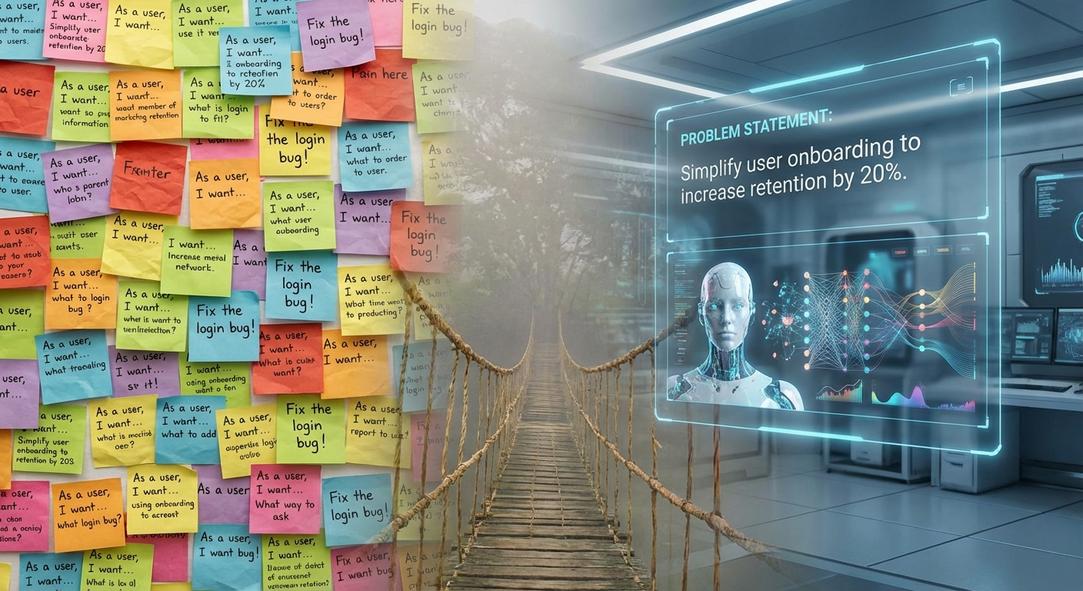
For years, the user story has been the fundamental unit of work in agile development, the bedrock of our collaboration with engineering. But is its reign coming to an end?
With the rise of powerful AI coding assistants and agents, the nature of the developer workflow is changing rapidly. Engineers are increasingly becoming AI orchestrators, guiding tools that can interpret higher-level prompts and generate vast amounts of code. The classic, granular user story—“As a user, I want X so that Y”—can feel like an inefficient way to leverage this new capability.
This isn’t just an engineering shift; it fundamentally impacts the PM-dev handoff. If a developer can generate a feature from a problem statement and a rough prototype, our time might be better spent on meticulously defining the problem space, constraints, and desired outcomes, rather than decomposing work into tiny, prescriptive chunks. We may be moving from specifying the “how” to providing a crystal-clear “what and why.”
This evolution could free up PMs to focus more on strategy, discovery, and validation, but it requires a new level of trust and a different kind of collaboration with our technical counterparts.