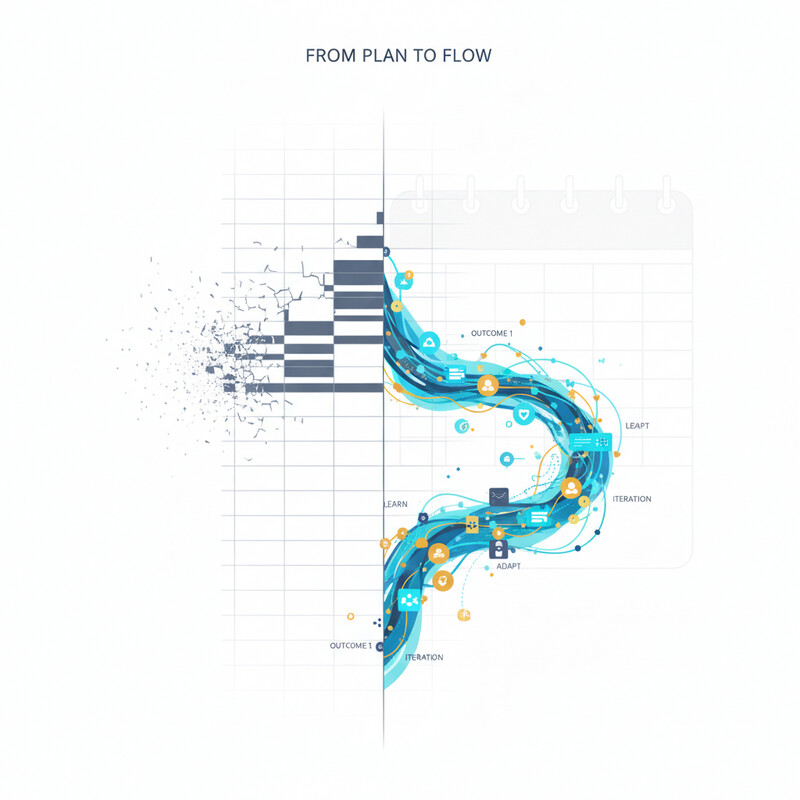
We’ve all been there. A senior stakeholder asks, “What features are we shipping in Q4?” and points to a Gantt chart that feels more like a prophecy than a plan. For years, the traditional, time-based roadmap has been the central artifact of product management, providing a comforting illusion of certainty.
But in a truly agile environment, is this relic holding us back? Committing to a fixed feature list months in advance stifles innovation and ignores a simple truth: we learn as we go. It chains the team to delivering outputs, not achieving outcomes, turning us into a feature factory.
The conversation is shifting—and for the better—towards outcome-based roadmaps. Instead of promising ‘Feature X,’ we commit to ‘Improve user retention by 10%.’ This reframes the work, empowering engineering and design to find the best solution, not just build the prescribed one. It requires a deep, continuous understanding of customer problems and clear team alignment, which is where transparent platforms like https://leera.io can bridge the gap between user insights and strategic goals. This isn’t about having no plan; it’s about having the right kind of plan—one that embraces uncertainty and focuses relentlessly on value.
So, where does your organization stand? Are you still living by the feature-based roadmap, or have you successfully made the shift to being outcome-driven?