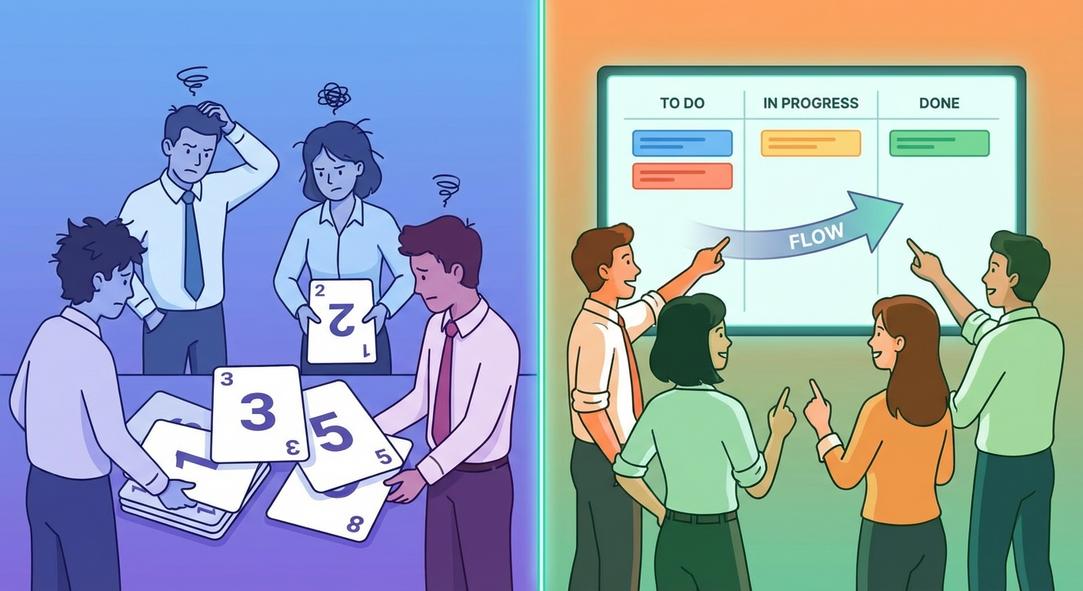
It feels like agile dogma: you can’t have a sprint without planning poker and story points. For years, we’ve used the Fibonacci sequence to abstract effort, foster discussion, and calculate velocity. But a growing number of teams are asking a provocative question: is this the most valuable use of our time?
The argument against story points is compelling. They often create an illusion of precision, can be misused by leadership as a hard commitment, and lead to lengthy, low-energy estimation meetings. The focus shifts from delivering value to debating whether a task is a 3 or a 5.
What’s the alternative? A move towards flow-based metrics. Instead of estimating effort, these teams focus on optimizing the end-to-end workflow. They measure cycle time (how long a task takes from start to finish) and throughput (how many work items are completed per week). This data-driven approach provides a more predictable forecast based on actual past performance, not abstract guesses. By focusing on smaller, well-defined stories and a consistent flow, planning becomes simpler and delivery becomes more reliable.
This isn’t just about changing how we count; it’s about changing the conversation from ‘how big is it?’ to ‘how can we deliver this faster?’.