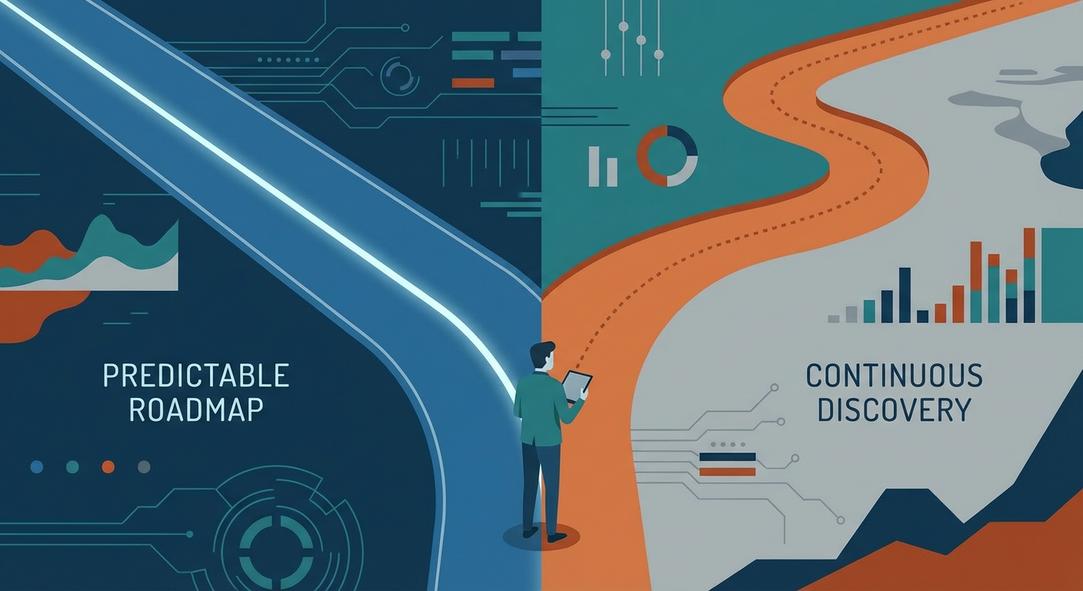
We’re all told to ‘fall in love with the problem’ and embrace continuous discovery. We run user interviews, map opportunities, and test prototypes. But then we walk into a leadership meeting and get asked for a detailed feature roadmap for the next 12-18 months. Sound familiar?
This is the central tension for modern product teams. We operate in a dual-track world: the messy, iterative loop of discovery and the business’s demand for certainty and long-term predictability. The push for agile and user-centricity clashes with the gravitational pull of the annual planning cycle. Too much focus on the roadmap turns us into a feature factory, churning out outputs with little regard for outcomes. But abandoning the roadmap entirely can feel like chaos to stakeholders and leave teams without a north star.
The answer isn’t to pick a side, but to evolve our practice. We need to shift from feature-based timelines to outcome-oriented roadmaps. We must get better at communicating our confidence levels and framing the roadmap as a statement of intent, not a commitment etched in stone. It’s a masterclass in managing expectations.
So, how are you navigating this challenge in your organization?