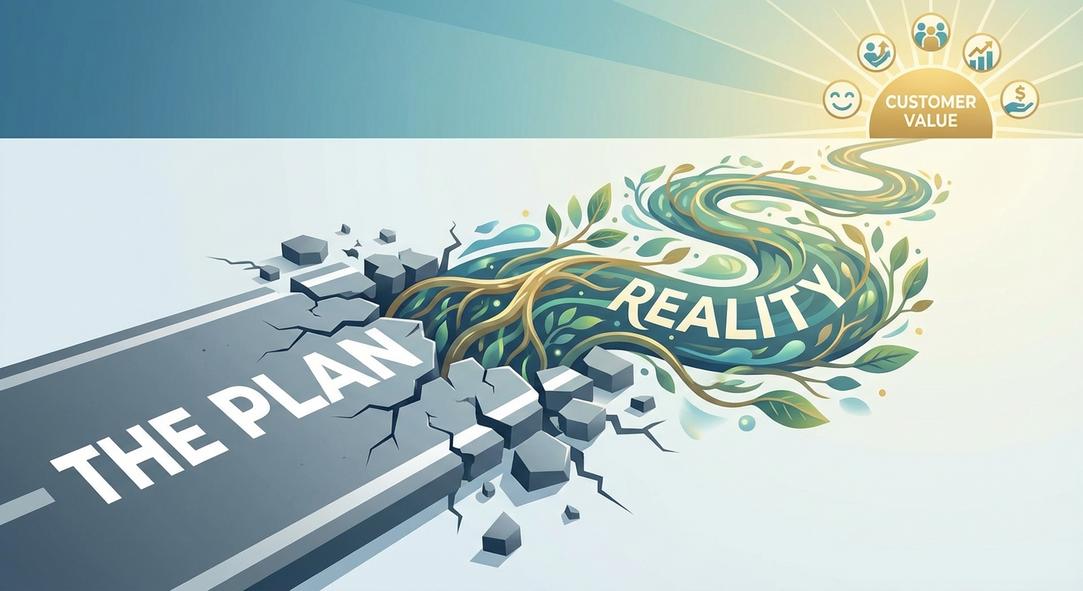
How often have you been asked for the detailed Q4 feature list… in January? Leadership and sales teams crave the certainty of a 12-month, feature-level roadmap. It feels safe, predictable, and easy to communicate. But let’s be honest: for most of us working in agile environments, that document is a work of fiction the moment it’s published.
We champion our ability to learn, iterate, and pivot based on user feedback and data. Yet, we lock ourselves into an output-based plan that prioritizes shipping features over achieving outcomes. This fundamental conflict creates a ‘feature factory’ culture, where success is measured by checking boxes, not by moving metrics or solving real customer problems. The team’s ability to innovate and respond to the market is hamstrung by a plan that is inevitably already obsolete.
Shifting the conversation from a timeline of features to a sequence of customer problems-to-be-solved is the only way to bridge this gap. It aligns everyone on goals, not just solutions.
How do you manage stakeholder expectations for long-term predictability while protecting your team’s ability to remain truly agile?